

Get Started
SSH-MITM acts as a proxy between an SSH client and its server. Placed on the network path, it terminates both connections independently and forwards all traffic — giving the auditor full visibility while the session continues normally from the user’s perspective.

Install
No installation required — download and run:
$ wget https://github.com/ssh-mitm/ssh-mitm/releases/latest/download/ssh-mitm-x86_64.AppImage
$ chmod +x ssh-mitm-x86_64.AppImage
In all commands below, replace ssh-mitm with ./ssh-mitm-x86_64.AppImage.
$ sudo snap install ssh-mitm
$ flatpak install flathub at.ssh_mitm.server
$ pip install ssh-mitm
For a full list of installation options see Installation.
Start SSH-MITM
Point SSH-MITM at the target host — use a system you are authorized to test:
$ ssh-mitm server --remote-host <target-host>
Route a client connection
Have the SSH client connect through SSH-MITM on port 10022:
$ ssh -p 10022 user@<mitm-host>
SSH will display a host key fingerprint prompt — accept it to continue. See SSH Fingerprints for a full explanation of the fingerprint mechanism and why it matters.
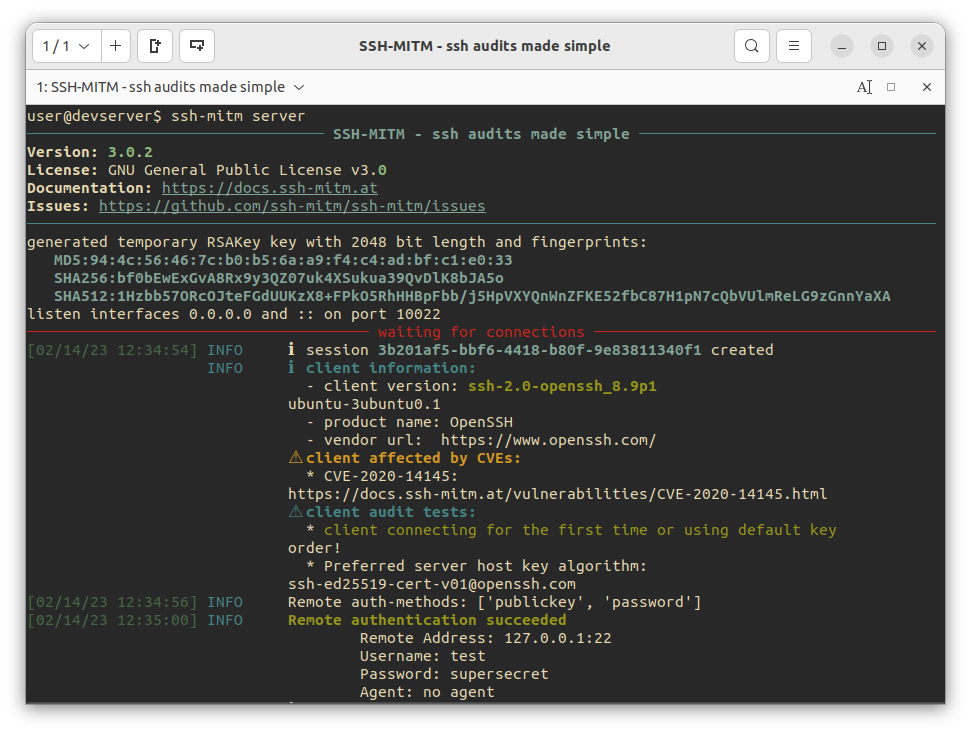
SSH-MITM intercepts the session and logs the credentials immediately:
Attach to the live session
For every intercepted connection, SSH-MITM opens a mirrorshell on a local port:
Connect to it from a second terminal — no password required:
$ ssh -p 34463 127.0.0.1
The mirror shell reflects the session in real time. Commands typed in either window appear in both. The auditor can also inject commands independently, without the user noticing.
Interactive tutorial
No target server available? The interactive tutorial simulates all scenarios using a built-in mock SSH server:
$ ssh-mitm tutorial
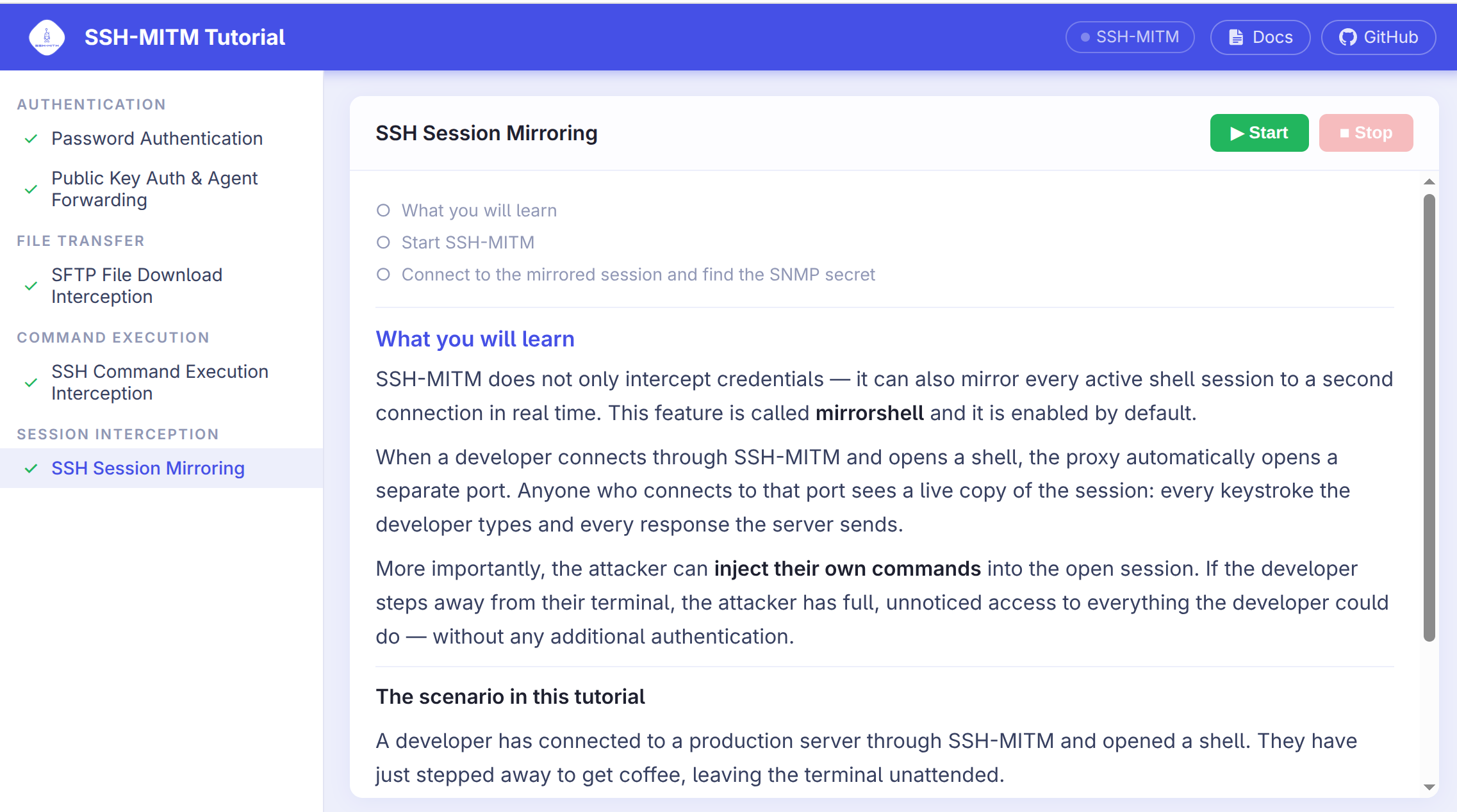
The tutorial runs across two windows. In the terminal, SSH-MITM logs what it captures from each simulated session. In the browser, each chapter describes the scenario and asks you to locate the intercepted value in the proxy output.
All chapters are set during an authorized assessment of Logfile Inc.
About the Assessment — Logfile Inc.
Before starting, read about the company, the staff members you will encounter, and the internal infrastructure that connects them. Every chapter builds on the same story.
Max Morgan connects to the web server for the first time. SSH-MITM inserts itself in the connection, Max accepts its host key without checking the fingerprint, and a second connection reveals his fingerprint state through CVE-2020-14145 — before any credential is entered.
Max connects to the web server using password authentication. SSH-MITM logs the username and password in cleartext. The proxied session continues normally on the remote server.
Sarah King switches to key-based authentication with agent forwarding. SSH-MITM records the accepted public key fingerprint. The forwarded agent is accessible through the proxy and can authenticate to further systems as Sarah.
Max downloads a file from the internal file server via SFTP. SSH-MITM logs every SFTP operation, including the file path and the transferred content.
Max’s automated deployment script runs a non-interactive command on the web server via SSH exec. SSH-MITM captures the exact command string and the server response.
Thomas Webb opens an SSH session to the core router and leaves the terminal unattended. SSH-MITM exposes the session via a local mirrorshell port. An auditor attaches to the port and reads the device configuration while the original session remains active.
An intercepted git clone reveals an internal Git platform —
LogfileGit. User profiles list registered SSH public keys — the
same keys developers use to log in to servers. check-publickey
queries the SSH user validity oracle (CVE-2016-20012) for each key,
mapping mmorgan’s lateral movement paths across the infrastructure.
The Logfile Inc. assessment is ongoing. More chapters are in development — covering additional techniques and scenarios encountered during the engagement.
Go deeper
The Audit Guide covers all interception techniques in depth — authentication, file transfers, port forwarding, protocol-specific interception, and client auditing.